
Why Brands Are Embracing the Unexpected


For a long time, commercial spaces followed a fairly predictable formula.
Good materials. Good lighting. Good furniture. A carefully considered colour palette.
Whether it was a restaurant, retail store or workplace, the objective was often to make the space look right.
But something is changing.
Brands are beginning to realise that looking good isn't always enough. In an increasingly visual and digital world, physical spaces need to give people something to experience.
That is where the unexpected comes in.
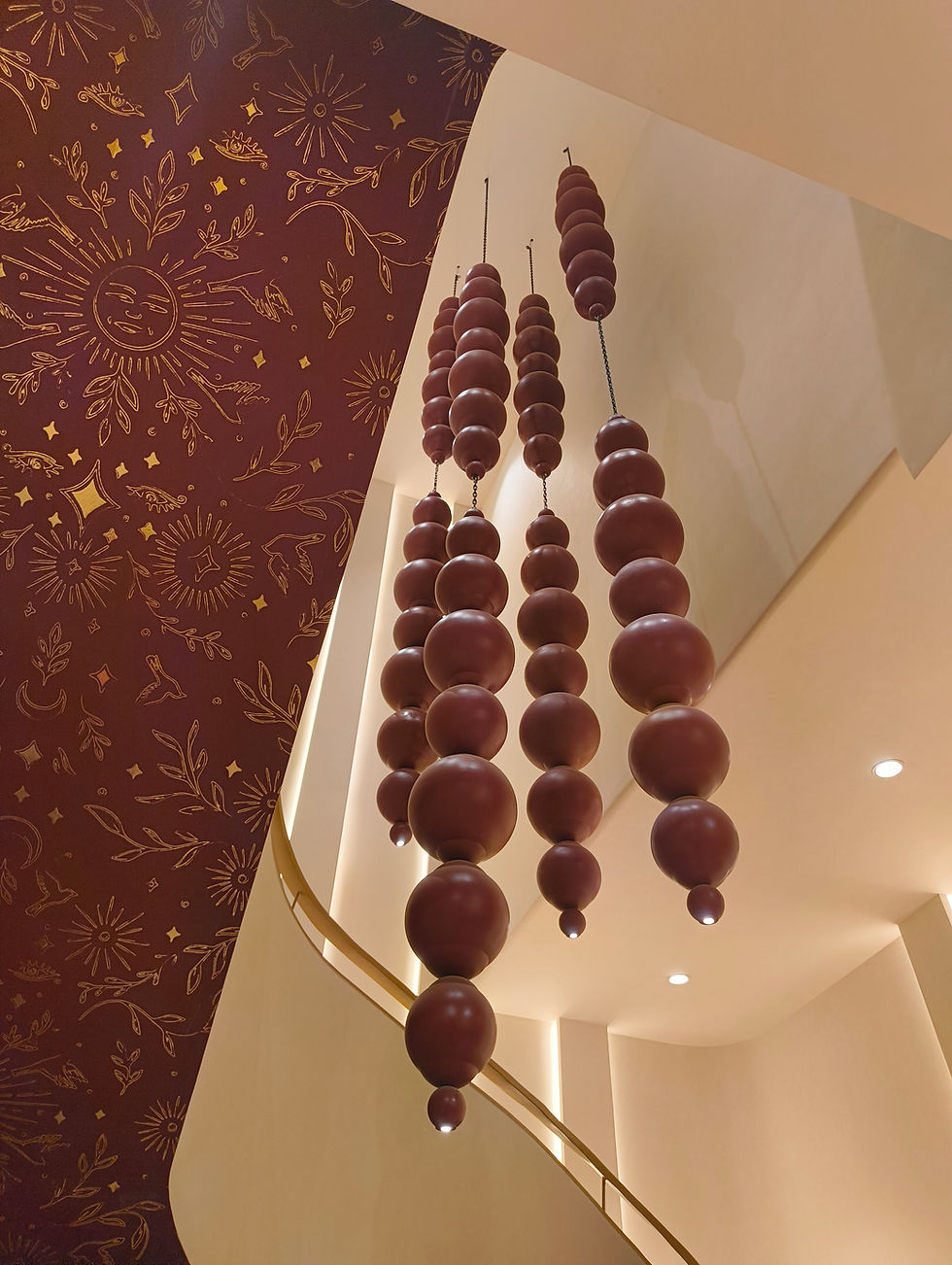
A kinetic installation. A giant sculpture. A retail fixture that moves. A light that becomes an architectural object. A wall that responds to people.
The space starts doing something.
From decoration to interaction
In India, this shift is particularly interesting.
We have always had a culture of spectacle, but contemporary commercial interiors have often borrowed a relatively restrained global design language. The result is that many restaurants, offices and retail environments can begin to feel interchangeable.
Technology and digital fabrication are changing what is possible.
3D printing allows us to create large sculptural forms and highly customised elements without relying entirely on conventional fabrication. Kinetic systems allow objects and architecture to move. Bespoke lighting can turn a functional fixture into a defining spatial element.
The point isn't to add technology for the sake of it.
It is to create something that couldn't have existed otherwise.
When the experience becomes the brand
For Gully Labs, we explored this idea through a retail delivery system.
Instead of simply handing a customer a shoe, we designed a mechanical shoe lift using three ball-screw channels that physically moves the product.
The delivery becomes part of the retail experience.

We've approached other projects similarly, using 3D printing to create sculptural retail elements, developing kinetic lighting systems, and designing bespoke lighting pieces that become focal points within restaurants, workspaces and retail environments.
In each case, the object is doing more than filling space.

It is communicating something about the brand.

Why now?
Part of the answer is social media.
People photograph spaces. They share them. They remember unusual objects. A distinctive installation can travel far beyond the physical boundaries of a store or restaurant.
But designing purely for Instagram rarely works.
The strongest spaces are not designed to be photographed. They are designed to make people feel something first.
Surprise. Curiosity. Delight. Sometimes even confusion.
That moment of stopping and thinking, What is that? is valuable.
Because in a world where almost everything can be scrolled past, attention has become part of the physical design brief.
Designing behaviour
This is the territory we are interested in at Amorphous.
We don't just want to design what an object looks like.
We want to explore what it does.

How does it move? How does someone interact with it? How does light change the atmosphere? How does a product arrive? How can a piece of fabrication become part of a brand's identity?
The most memorable element in a space isn't always the most beautiful.
Sometimes it is the one that moves.
Sometimes it is the one that feels slightly impossible.
Sometimes it is simply the one that makes you stop.
We think that's where the future of spatial design gets interesting.

Comments